

My Garage Door Opener Stopped Working: Quick Fixes for Austin Residents
You press the button on your visor at 7: 45 on a Tuesday morning, and nothing happens. Your garage door won’t move. MoPac backs up to 183, and you calculate your life expectancy of making it to your meeting on time. Sound like you? If you’re a homeowner in Austin than yes, you. We’ve all been there.
The good news is that most reasons your garage door opener will fail are preventable and simple things you can check in less than five minutes. Before you pick up the phone to customer service, wait an hour on hold, or throw your Hands towards the Sun, read this list first.
Before you read further, try these simple fixes:
- Make sure the opener is plugged into the outlet
- Press “Reset” on your garage GFI outlet
- Replace batteries in your remote. (Then try pushing the button on the wall.)
- Wipe safety sensors with a dry cloth.
- Check for spiders, dust, or insects in the sensor beam.
If the problem still exists, read on. We take care of everything below.
Basic Basics: The 2-Minute Fixes
Look before you panic. Sometimes, the most obvious solutions end up being the problem. In fact, more times than you would think, one of these three simple fixes will solve your issue.
Power. First, head down to your opener unit mounted to the ceiling and ensure the power cord is securely plugged into the outlet. It’s easy to overlook something so simple, but vibration from years of daily use can work a plug loose even if it appears connected.
Tripped GFI outlet. A lot of garage outlets in Austin houses — especially newer homes — are wired as Ground Fault Interrupter (GFI) circuits (aka GFCI receptacles). The GFI outlet trips when there’s an electrical surge. Electrical surges here in Central Texas are pretty common due to thunderstorms. Find the GFI outlet in your garage (they’re sometimes located near the service door or workbench) and see if the little RESET button has popped out. Push it back in and that may be all you have to do.
Remote batteries. If you’ve determined the unit has power, but your remote still fails to function, try your wall-mounted button inside the garage. If the wall button works but your remote doesn’t, congratulations, you’ve identified your problem. Batteries in remote controls die quickly. Replacing them will cost you about $3 at H-E-B or Home Depot.
Austin-Specific Troubleshooting
After eliminating the common issues, now consider something unique to the Austin area: Texas weather really wreaks havoc on garage door systems in ways that many other regions around the country don’t experience.
Garage Door Sensor Troubles Caused by Cedar Pollen/Dust
If you’ve lived through one Austin Cedar Fever season, you know that pollen in these parts is serious business. That yellow-green dust gets everywhere – even on the little safety sensors (photo-eyes) mounted a few inches off the ground on both sides of your garage door opening. These photo eyes beam an invisible signal across the opening, and when anything interrupts that beam, the garage door opener won’t close for safety reasons.
Heavy dust/pollen buildup on the sensor lenses is one of the leading causes of “broken” garage doors in Austin that are really just dirty. Wipe the face of each sensor with a soft, dry cloth. Then observe the indicator lights. Solid and steady is good. If it’s blinking or dim, the sensors are misaligned or still blocked. A gentle tweak of the sensor bracket angle will usually clear things right up.
Heat-Induced “Brain Fog”
It gets hot here in Austin. When the outdoor temperature hits 100+ degrees consistently, your garage (particularly if it’s uninsulated or faces west) becomes even hotter. Prolonged exposure to that intense heat can cause the opener’s logic board to get confused, and metal parts like the tracks can expand just enough that they start to bind up and offer resistance that your motor can’t overcome.
If your opener is running slowly or pausing partway through a cycle during the warmest parts of the day, your first course of action should be to lubricate. Grab a silicone-based lubricant (NOT WD-40 or thick grease). We like WD-40 Specialist White Lithium Grease or 3-IN-ONE Garage Door Lube. You can find these at either the Mueller or Westlake Home Depot. Thick grease will pick up on the fine dust and debris floating around Austin all the time, becoming a grinding paste. Silicone-based products will stay cleaner and won’t gum up your tracks or rollers.
Critter Interference
This may seem odd to many people, but if you have lived in Austin any longer than a summer month, it likely won’t. Geckos, little insects, and spiders LOVE to crawl up into warm sensor brackets or hide out in corners around your garage door frame. A tiny web across a sensor beam or a gecko hanging out on your photo-eye won’t take any longer to activate the safety mechanism than your child standing in the doorway.
Give your sensors a quick visual inspection. This is best to do in the early morning hours once everything has had all night to congregate. Clear away webs, look for any “critters” sitting on the beam, and try your door again.
Manual Operation: How to Get Your Car Out Right Now
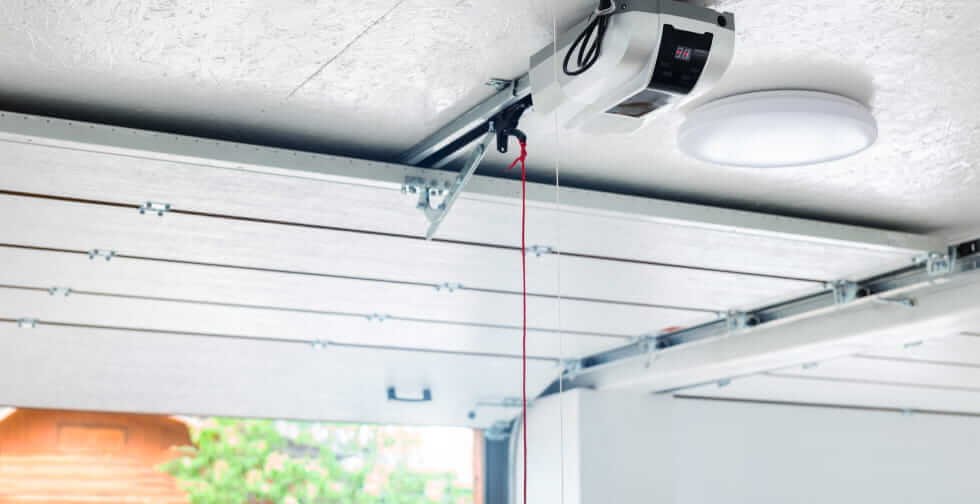
Find the red rope that hangs from your opener’s trolley. This is the emergency release cord. Pull it to disconnect the door from the electric drive system and operate it by hand. Crank the door up, drive out, and pull the door closed behind you.
Do NOT use the emergency release if the door is open and you think you have a broken spring. The door has abnormal tension on it when the spring is broken, and it will fall quickly when released from the opener. If you heard a loud noise earlier, don’t do this. Just call us immediately.
When It’s Not a Quick Fix: Knowing the Danger Zones
Some garage door issues can easily be handled by a homeowner. Others involve parts strung up under incredible mechanical tension that will rip your fingers apart like bubble gum if you’re not careful. Here’s how to tell which is which.
The Snap Test: If your issue started with a sound like a gunshot coming from inside your garage… you’ve got a broken torsion spring. Torsion springs are strung up really, really tight. Do not attempt to rewind these springs yourself. You need a professional with special winding bars and the knowledge of how to use them.
Cable Check: Open your garage door and inspect the cables that run along each side, near the bottom of the door. If they’re cut, snapped, or otherwise dangling loose, back away from the garage door. Cables are only safe when under extreme tension, like your springs.
Noise Your Lubricant Won’t Fix: If your opener is grinding, scraping, or making metal on metal contact even after lubrication, you’ve got a structural problem. See bent track, worn drive gear, or dead roller. Time to contact a professional.
Rule of Thumb: If your DIY project involves torsion springs, cables, or anything else under extreme mechanical tension, stop. Call a professional.
Still having problems? Two Brothers Garage Doors is here to help.
Nine times out of ten, if your garage door opener isn’t cooperating, it’s due to something easy to fix. A tripped GFI, a dirty sensor lens, or a dead remote battery is typically all it takes to throw you off track. Central Texas can give you a few unique problems with cedar season, 100-degree days, and unexpected lizards on your photo-eye as well, but those are typically easy fixes once you understand the problem.
If you’ve gone through this entire list and something still isn’t right with your garage door, don’t try to wrestle with a 300lb door all weekend.
We cover the entire Austin metro area, and most of the time, we can be with you and have you up and running the same day. Round Rock, Cedar Park, Pflugerville, and even Kyle! So give us a call or drop us a note using our contact form anytime to schedule service 24/7.

